
On this page
What you need to know now
The invitation-led launch described in this 2023 post has passed. Registration is now available to persons required or entitled to register, using the current FTA service and the correct legal-person profile.
The original article is preserved below as a historical record. Earlier deadlines, rates, offers and approval statements should not be used as current guidance.
- Check scope and the applicable deadline before beginning the application.
- A UAE branch of a domestic company is generally part of its head office, not a separate legal person.
- Keep the application acknowledgement and respond to FTA requests.
What has changed since the launch
The February 2023 article records an early stage of Corporate Tax registration. Its restricted launch categories and future announcements should not be interpreted as the current limit on who can register. Use the live FTA service and assess the person’s present obligation or entitlement. A company should not wait for an individual invitation merely because the original rollout began through a phased process. Keep the original publication date to make that historical context clear.
Choose the correct taxable-person profile
Match the applicant to its legal documents before creating or selecting the EmaraTax profile. Check whether the business is a company, an individual carrying on activities or another relevant person. A UAE branch of a domestic company generally belongs to the same legal person as its head office, so a branch label should not automatically trigger a separate registration. Conversely, common shareholders do not turn separate companies into one applicant without the applicable legal basis.
Prepare a coherent registration file
Collect the incorporation or other formation document, current licences, ownership information and evidence of the signatory’s authority appropriate to the applicant. Review names and dates across the documents before entering them. Keep a copy of the submitted information and the application reference. If the FTA requests clarification, respond with an explanation consistent with the original facts rather than replacing documents without showing what changed. Accurate information at this stage supports later returns and correspondence.
Do not confuse registration with a group return
An approved registration establishes the account position for the relevant person. It does not itself allow unrelated or separately registered companies to submit one consolidated return. Any Corporate Tax group treatment requires its own conditions and process. After approval, verify the recorded financial period and registration details and prepare a separate filing calendar. Assign responsibility for account messages, return preparation and final approval so the registration launch becomes the starting point of ongoing compliance rather than the only task completed.
YOUR NEXT STEPS
A practical way forward
- 01
Confirm scope
Identify the company, individual or other taxable person.
- 02
Check the profile
Ensure the EmaraTax record and legal documents describe that person.
- 03
Apply and monitor
Submit a complete registration and track requests through approval.
CLEAR ANSWERS
Frequently asked questions
Are only private and public joint-stock companies able to register now?
No. That was early launch information; use the current FTA service eligibility.
Must each domestic branch register separately?
A domestic company’s UAE branches are generally extensions of the same legal person.
Read the original article First published 13 February 2023 · retained for context
This earlier article is preserved for context. Its rates, deadlines, approvals and announcements may have been superseded. Use the current guidance and official references on this page for your next step.
Corporate Tax Registration Starts in UAE – How to register?
Corporate Tax Registration Starts in UAE. All corporations are required to register with the Federal Tax Authority and obtain a Corporation Tax Registration ID. This applies to all businesses, regardless of the corporation tax rate they are subject to (0% or 9%). To ensure a smooth and hassle-free process, it’s advisable to seek assistance from professional corporate tax advisors in the UAE who can help with all aspects of tax registration
Corporate Tax Registration – Who can register for now?
- Private Companies, including Establishments.
- Public Joint Stock Companies.
Note: Information regarding registration for other legal entities and natural persons will be provided at a later date. (Click here for latest updates)
What do you need for the registration process?
- Legal structure and relevant documents for your business, such as a license and Memorandum of Association (MOA).
- Information and identification documents for the owners or authorized signatory, including Emirates ID and passport.
- Documentation to verify the authorization of the authorized signatory, such as the MOA and Power of Attorney.
Corporate Tax Registration : Where can you register?
Online through https://eservices.tax.gov.ae/
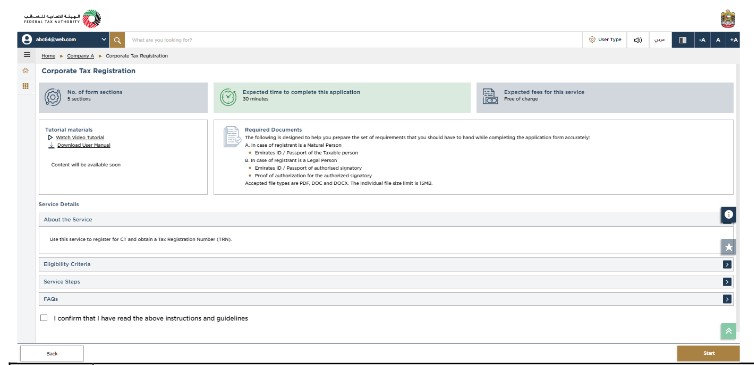
UAE CT Registration
UAE Corporate Tax Return Filing
The FTA requires that businesses be allowed to file a single consolidated tax return, rather than requiring them to file multiple returns. This consolidated return must be filed within nine months of the end of each relevant tax period.
To find out more about e-filing corporate tax returns in the UAE, Please contact us : Saif Chartered Accountants, Dubai, UAE.
UAE Corporate Tax deadlines
The corporate tax regime is based on a self-assessment principle which means businesses are responsible for ensuring that the documents they submit to the FTA are correct and comply with the law.
The new UAE corporate tax regime allows taxpayers up to 21 months from the start of their financial year to prepare for filing and making their tax payments.
For example, businesses with a financial year starting on June 1, 2023, and ending on May 31, 2024, have until February 28, 2025 to file their corporate tax returns and make their payments.
For a business whose first tax period begins on January 1, 2024 and ends on December 31, 2024, the return and payment must be filed between January 1 and September 30, 2025.
Related : VAT Consultancy Service
VERIFY THE DETAIL
Official sources & further reading
Source checks support this general guide. Your treatment depends on the facts, tax period and applicable legislation.